

About us
Press Room
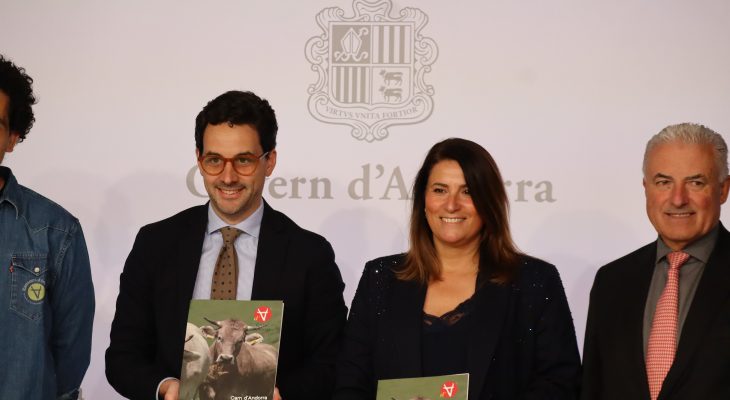
The bank will continue to cover 25% of the sale price of this locally sourced product supplied to schools across the country
The main aim is to raise awareness of the importance of Andorran livestock farming and the quality of
its products, which come from extensive and sustainable farming. With this objective in mind, the
Government renewed its collaboration agreement with Andbank on Tuesday morning. Under the
agreement, the country’s bank will continue to provide financial support to cover part of the cost of
distributing Andorran Meat to all schools in the country. This was explained by the Minister for the
Environment, Agriculture and Livestock, Guillem Casal, and Andbank’s Director of Domestic Banking,
Maria Suárez, following the signing ceremony, which was also attended by Gerard Martínez, manager
of Ramaders d’Andorra, and Josep Maria Cabanes, Andbank’s Director of Institutional Relations.
“By renewing this agreement, we are guaranteeing the distribution of locally sourced meat to schools
throughout the country,” Minister Casal said. He stressed that the agreement helps showcase the
value of Andorra’s livestock sector, which contributes to conserving the mountains, protecting
biodiversity and reducing natural hazards. Suárez added that “thanks to this renewal, the project is
becoming more firmly established and strengthened, enabling an increasing number of schools to
include local produce on their menus.”
Under the terms of the agreement, Andbank will cover 25% of the sale price of Andorran Meat supplied
to schools, up to a maximum annual amount of €15,000. This maximum amount is unchanged from
the previous agreement and, since 2022, almost the entire allocated budget has been used, thereby
achieving the objective of bringing locally produced meat closer to schools.
The agreement also provides for the bank to support training activities for the livestock farmers who
are members of the company by making training facilities available free of charge. The company will
organise one training session per quarter, up to a maximum of four sessions per calendar year.

La Federación Andorrana de Tenis y Andbank firman un convenio histórico para promocionar el deporte en todo el país

Andbank presents the AndUp Foundation, focused on accelerating growth-stage startups with a real impact on the country

Andbank welcomes the new participants in its summer Trainee Program